How to write prompts for GPT Image 2.6 Flare
GPT Image 2.6 Flare makes pictures from a sentence and edits the pictures you give it. The first two sections put OpenAI’s own prompting guide in our words, and we did not test them. The last rests on one sample picture made with this model that we looked at ourselves, so it is a very small sample.
Written from the provider’s documentation and from results we checked ourselves. Last checked November 8, 2026.
Make something with GPT Image 2.6 FlareThe GPT Image 2.6 Flare model page
Where OpenAI places Flare, and how to define the result
From the provider’s documentation
- OpenAI calls GPT Image 2.6 Flare the smaller model, for workflows where speed matters most, and GPT Image 2.6 Sunburst the base model, for work that needs more detail or precise edits. Its advice is to start with Flare when response time matters most and, if Sunburst already meets your needs, to try Flare with the same prompts and pictures and compare.
- OpenAI warns that the same quality label does not mean the same image quality or response time across models. On Pickshot the shelf lists Flare at a high quality setting and Sunburst at a medium one, so compare them with one prompt rather than by label.
- To define the result, name the subject and what the picture is for, such as a product photograph, an advertisement or a diagram, then the composition, the aspect ratio and anything that must sit in a given place. For a complex request, organise the prompt as labelled parts: scene, subject, details and constraints.
- Short prompts, paragraphs, JSON-like structures and tags can all work. Choose the format that is easiest to read and to update.
Visible details, people and iteration
From the provider’s documentation
- Name what can be seen: materials, light, colours and the medium. Ask for “photorealistic” or “a real photograph” outright when that is the goal. Camera specifications act as cues for a look, not as exact optics.
- For wide, cinematic, low-light, rainy or neon scenes, give the scale, the atmosphere and the colours rather than relying on mood words alone.
- For people, describe the framing, the relative size, where they look and what they do with objects, for example full body visible with the feet included.
- Iterate on purpose. Pass the previous result back in, ask for one change and repeat the details to keep. If the result drifts, restate the constraints before adding more instructions.
What our one sample picture showed
From results we checked ourselves
- The sample is a misty pine ridge above a sea of clouds at sunrise. The prompt asked for “Korean ink painting mood”, soft gold light and a wide view. The picture has the clouds, the pines on the ridge, the low sun and the soft gold light in a wide frame.
- It reads as a photograph. The ink painting mood shows up as layered, muted distance and thin mist, not as brush strokes. OpenAI says to ask for the medium outright, so a prompt that names the medium itself, for instance ink wash painting, may get closer. We did not test that.
- One picture is a very small sample, so we say nothing about text, edits or how often this happens.
Real results and the prompts behind them
Results made with this model. The prompts are shown exactly as written, in English.
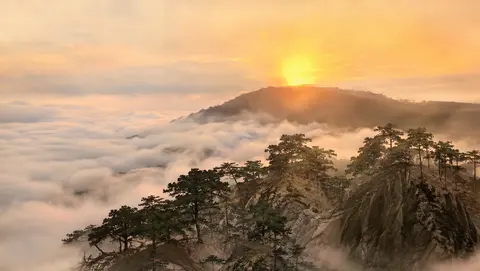
A misty pine ridge above a sea of clouds at sunrise, Korean ink painting mood, soft gold light, wide view
Settings of this model
- Van
- OpenAI
- Typ
- AI image model
- Manier van maken
- Tekst naar afbeelding · Afbeelding bewerken
- Resolutie
- 1K / 2K
- Prijs
- from 90 / image
Vragen
Should I use GPT Image 2.6 Flare or Sunburst?
OpenAI says to start with Flare when response time matters most and with Sunburst for demanding detail, layout or edit accuracy, and to compare them with the same prompt. We have not compared them, and they have separate pages and guides here.
Does a mood word change the medium?
In our one sample, asking for an ink painting mood gave a photographic picture with soft, layered distance. OpenAI says to name the medium outright when you want a particular one.
How do I get a photograph look?
OpenAI says to ask for photorealistic or a real photograph and to describe the framing, the light and the textures. Camera specifications work as cues for a look, not as exact optics.
Provider documentation we read
We read these pages and wrote the points that matter in our own words. The provider may change them.
- Image prompting guide (OpenAI) (developers.openai.com)
- Image generation guide (OpenAI) (developers.openai.com)
More prompting guides
- How to write prompts for GPT Image 2.6 SunburstAI image model
- How to write prompts for Nano Banana 2.1AI image model
- How to write prompts for MOSS ImageAI image model
- How to write prompts for Grok Imagine ProAI image model
- How to write prompts for Nano Banana ProAI image model
- How to write prompts for Nano Banana 2AI image model
- How to write prompts for GPT Image 2.5 FlareAI image model
- How to write prompts for IndigoAI image model
- How to write prompts for SaffronAI image model
- How to write prompts for CeladonAI image model
- How to write prompts for LapisAI image model
- How to write edit requests for UmberAI-afbeeldingseditor
- How to write prompts for Kling Video 4.0AI video model
- How to write prompts for Seedance 2.5AI video model
- How to write prompts for Seedance 2.0 MiniAI video model
- How to write prompts for Kling V3AI video model
- How to write prompts for Kling O3 OmniAI video model
- How to write prompts for Veo 3.1AI video model
- How to write prompts for Veo 3.1 FastAI video model
- How to write prompts for SilkAI video model
- How to write prompts for LacquerAI video model
- How to write prompts for SatinAI video model
De namen van modellen, bedrijven en producten op deze site zijn handelsmerken van hun eigenaren; Pickshot is niet verbonden aan, gesponsord door of goedgekeurd door hen.